
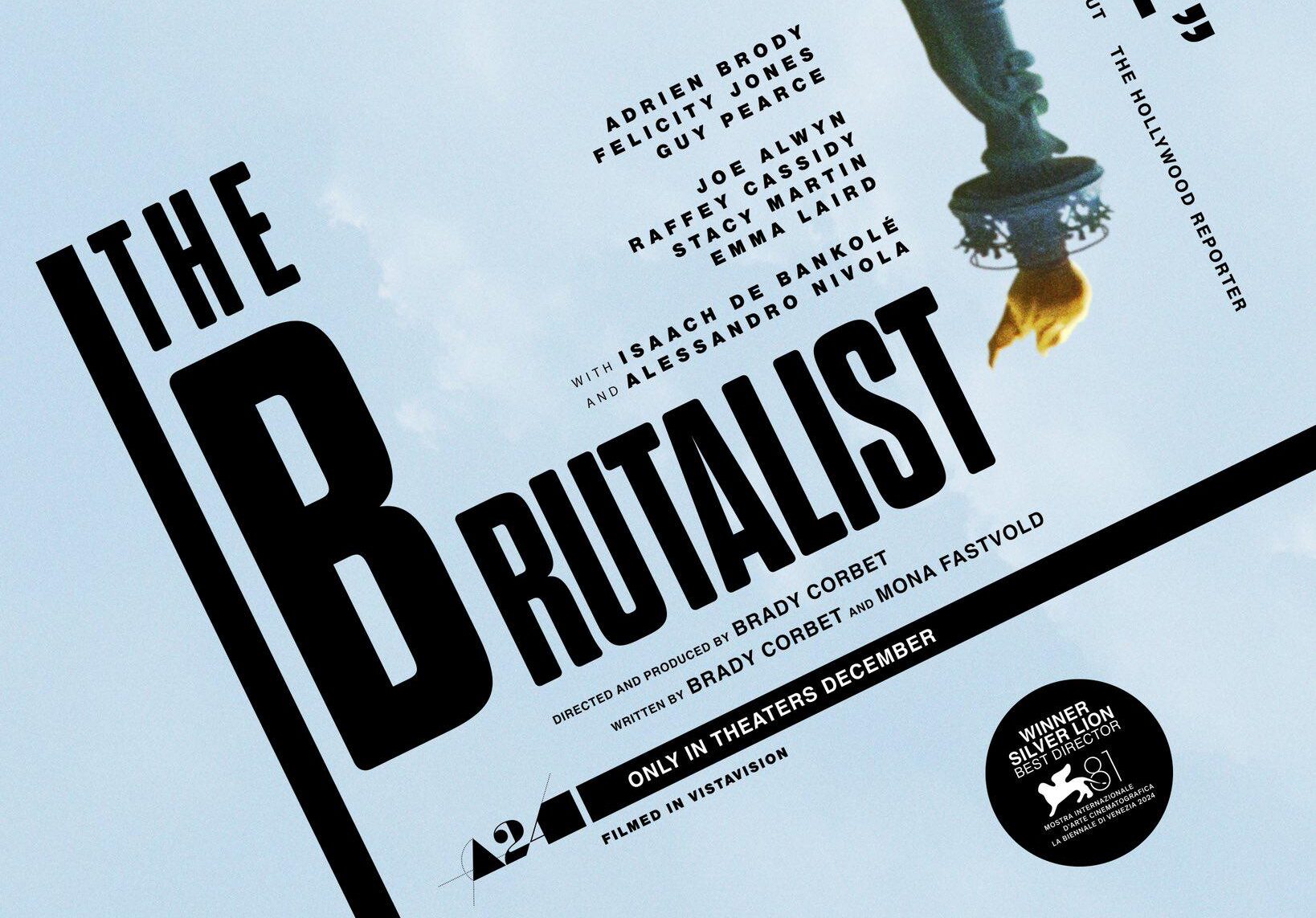

Why The Brutalist Is Really About Ownership
Most reviews of The Brutalist are going to tell you it is about architecture, trauma, ambition, America, or genius. All true. None of that gets to the center of it.
The Brutalist is about ownership.
Not ownership in the legal sense. Ownership in the uglier sense. Who gets to claim a work. Who gets to fund it, steer it, soften it, brand it, inhabit it, and finally stand beside it as if they made it too. Brady Corbet understands that the filthiest part of patronage is not that money corrupts art. It is that money wants authorship. It wants proximity to vision without surrendering power.
That is the movie.
A24’s synopsis gives you the basic shape: László Tóth, a postwar Hungarian architect, arrives in America to rebuild his life and is drawn into the orbit of wealthy industrialist Harrison Lee Van Buren, where “power and legacy come at a heavy cost.” That description is accurate, but too polite. The film is really about what happens when talent enters a room that already believes it owns the future.
Director: Brady Corbet
Cinematographer: Lol Crawley
Starring: Adrien Brody, Guy Pearce, Felicity Jones
Runtime: 215 minutes
Verdict: A major film about authorship, patronage, and power
Adrien Brody and Guy Pearce Sell the Power Dynamic
Adrien Brody is excellent because he refuses the easiest version of the part. He does not play László as a sainted exile or a tragic genius waiting for the world to catch up. He plays him as gifted, wounded, proud, difficult, vain, humiliated, hungry, and increasingly corroded by the terms under which he is allowed to work. That complexity matters. A lesser film would ask you to admire him first and understand him second. The Brutalist is smarter than that. It lets admiration and irritation sit in the same body.
Guy Pearce is just as important to why the film works. Van Buren is not interesting because he is rich or cruel. Plenty of movie rich men are rich and cruel. He is interesting because he behaves like the natural endpoint of patronage. He does not simply want to finance beauty. He wants beauty to confirm his rank. He wants genius near him, but beneath him. He wants to be the condition under which greatness becomes possible. That is a much nastier dynamic than simple villainy, and the film is at its best when it understands that.
How The Brutalist Uses Scale, Format, and Space
This is where the camera matters.
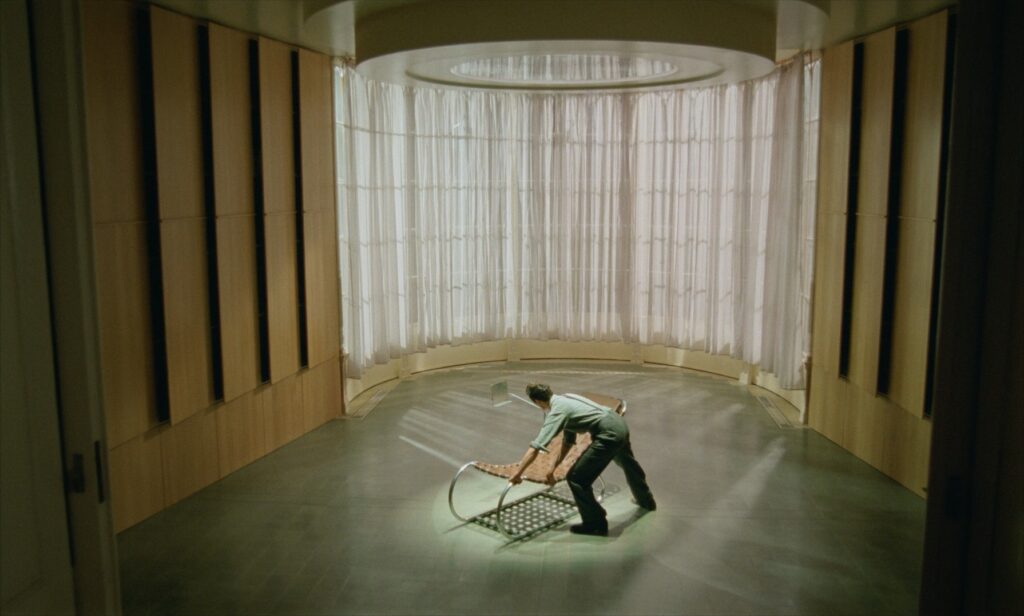
Corbet and cinematographer Lol Crawley shot the film chiefly in VistaVision. Crawley has said they ended up using VistaVision for the vast majority of the film because the images were extraordinary, and because using a technology engineered in the same decade helped them access the period. A24’s own disc specs also note a 1.66:1 presentation derived from the original 35mm negatives, with VistaVision footage scanned at 6K. Those facts matter because the movie does not use width and scale for empty grandeur. It uses them to make scale feel accusatory.
That is the film’s best formal idea.
In a weaker movie, large-format shooting would just become prestige decoration. Nice walls. Nice voids. Nice concrete. Nice light falling across expensive misery. Here, the width keeps turning grandeur into hierarchy. The frames do not simply show buildings. They sort people inside them. Doorways, corridors, desks, staircases, unfinished spaces, and ceremonial rooms all keep telling you the same thing in different ways: some people are allowed to occupy history, and some are only allowed to build it for them.
That is why the movie feels oppressive even when it is calm.
The best images in The Brutalist are not beautiful in the soft, lyrical, festival-brochure sense. They are stern. Sometimes cold. Sometimes humiliating. Sometimes so composed they border on punishment. Corbet is not using the frame to flatter emotion. He is using it to impose terms. Every time László gets something that looks like freedom, the image reminds you there is a bill attached.
That is much more interesting than the usual line about the film being “visually stunning.” Plenty of films are visually stunning. Most of them have nothing to say with their beauty. The Brutalist does. It understands that architecture is not just shelter or style. It is ideology you can walk into. It is power made habitable.
Why the Film Lingers
This is also why the film is more unsettling than inspiring. People are calling it monumental, and fair enough, but monumentality is not a compliment by default. Corbet knows that. He understands that monuments are never innocent. They are records of power, taste, exclusion, ego, and historical editing. The film gets a lot of force from treating artistic ambition as something both real and contaminated. László’s talent matters. His vision matters. But the movie never lets you forget that vision is being brokered, handled, and absorbed by structures bigger than the man himself.
That is where The Brutalist becomes more than a handsome period drama about suffering and genius. It becomes a film about America’s relationship to immigrant brilliance. America loves genius once it can stage-manage it. It loves innovation once it can own the building, the plaque, the ribbon-cutting, and the legacy narrative. It does not love the person in the same way. It certainly does not love the dependency, the friction, or the moral cost of the arrangement. The film is brutal about that, and it should be.
Where The Brutalist Stumbles
Where it stumbles is almost exactly where you would expect.
Corbet is a real formalist, which is a compliment until it isn’t. There are stretches where the film’s command hardens into self-regard. You stop feeling the pressure inside the story and start noticing the director’s grip on it. The movie’s scale begins to ask for admiration too often. Some of the ugliness that should feel inevitable starts to feel arranged. When that happens, the film loses a little of its menace because it becomes slightly too aware of its own importance.
That is not a fatal flaw. But it is the difference between a major film and an unquestionable masterpiece.
The second weakness is that the film is sometimes better at staging coercion than creation. This is a subtle but real problem. The Brutalist is incredibly persuasive when it shows how artists are used, managed, and humiliated. It is slightly less persuasive when it needs you to feel the full positive charge of what is being made. You understand the cost. You understand the control. You understand the psychic damage. The actual creative intoxication is more uneven. That keeps the movie a little more cerebral than devastating.
Still, those are the flaws of a film reaching too far, not a film with nothing inside it. I will take that trade every time. Most prestige cinema now is tidy, tasteful, and spiritually dead. It explains itself well. It lands where it should. It looks expensive. It disappears on contact. The Brutalist is not tidy. It has too much mass for that. Even when it strains, even when it stiffens, even when Corbet’s severity starts showing through the seams, the film still has something rare: a formal argument.
It knows what its images are doing.
That alone puts it above most of the films it will be grouped with.
Final Verdict
So no, The Brutalist is not great because it is long, important, architectural, or awards-friendly. It is great because it understands that scale is never neutral. A large room can be an honor or a humiliation. A commission can be a gift or a leash. A monument can be a triumph or a theft. Corbet and Crawley keep all of that inside the frame, and that is why the movie lingers.
The Brutalist is not a film about an architect building a legacy.
It is a film about the people who think they own it once he does.
That is a better, stranger, nastier movie than the prestige packaging suggests.

